
Every Google headline gets the same treatment from me now: how does this affect ads, could it affect ads, and is there something in here we can use for ads? The last filter is whether my team should be paying attention to it. Foundation’s research on video showing up in B2B software searches made the cut, so it went on the agenda for Growth Hour this week.
Growth Hour, for the folks who don’t know, is our weekly internal training session, where the ads team (and anyone else on the team who’s stuck) brings a problem to the room, and we work it through together, or I come in with an agenda talking about what’s been going on in my mind. This week we chatted about what was on my mind: what does it mean for paid when Google answers a B2B software search with a creator’s video?
If video keeps showing up on the B2B terms you already buy, audit those results pages first, then pick a route (the creators already ranking, or your own videos) and measure it against a baseline.
Google keeps answering B2B software searches with video
Ross Simmonds and his team at Foundation have been tracking this for months. In June, they analyzed 8,566 keywords across 130+ SaaS categories and found a YouTube video in Google’s top 10 organic results for 80.2% of “demo” searches, where the average CPC (cost per click) is $49. YouTube also showed up on about one in five “best” and “vs” searches. In July, they published a follow-up on Shorts: across more than 1,100 “best + software” searches worldwide, YouTube Shorts were showing up. The number reaching the top ten also grew over time, and AI answers were pulling from YouTube for the same kinds of questions.
Flow Agency published a separate check in November based on 1,500 high-intent US searches for HR and work-tech software. About two-thirds of those results showed a video carousel or a YouTube video cited in an AI Overview, and most of the videos in those carousels were roundups from creators and publishers reviewing the tools.
What the studies measured
There are a few caveats before anyone rebuilds a media plan around this. The studies count different things: Foundation’s June study and Flow counted regular YouTube videos, while Foundation’s July study counted Shorts, so I’m keeping their numbers separate rather than stacking them. The pattern also thins out as intent sharpens; only 4% of pricing searches in Flow’s sample had a video carousel. Video shows up where buyers are researching and comparing tools, and much less where they’re ready to talk price. Every one of these studies measures what appears on the page; none tracked who watched, clicked or bought, so what I’m talking about for pay per click is what I have inferred from the information.
Where that leaves the ads on the same page
Ross’s team has handed paid folks something to chew on before. Their March study of 8,566 B2B keywords found that on SaaS keywords costing $50+ per click, a Reddit thread outranked every vendor organically 67.3% of the time. I wrote about what that does to PPC signals for Search Engine Land; the terms advertisers pay the most for were the terms where a free thread was most likely to sit between the ad and the buyer.
So my first question reading the video data was whether the same pattern is showing up in a new format. Ross’s read is that Google leans on YouTube because Google owns it. If Google fills more of the page on these searches with creator videos, where does that leave the ads? None of these studies measured ad placement, so I don’t have an answer yet. That’s why it went on the Growth Hour agenda, and any advertiser can check it on their own terms today.
My own seven searches
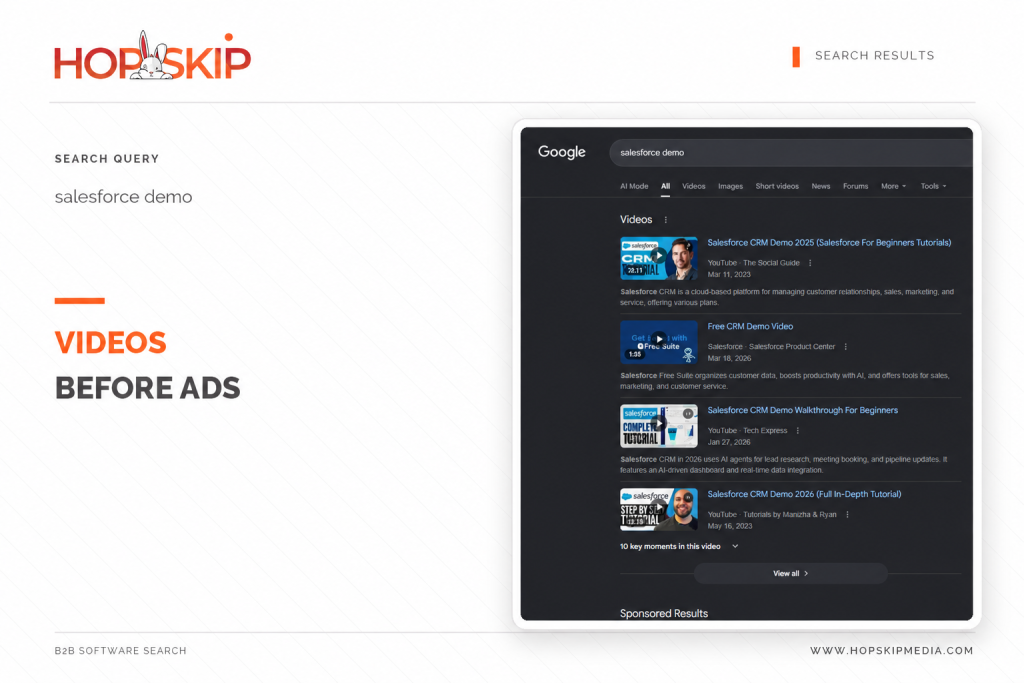
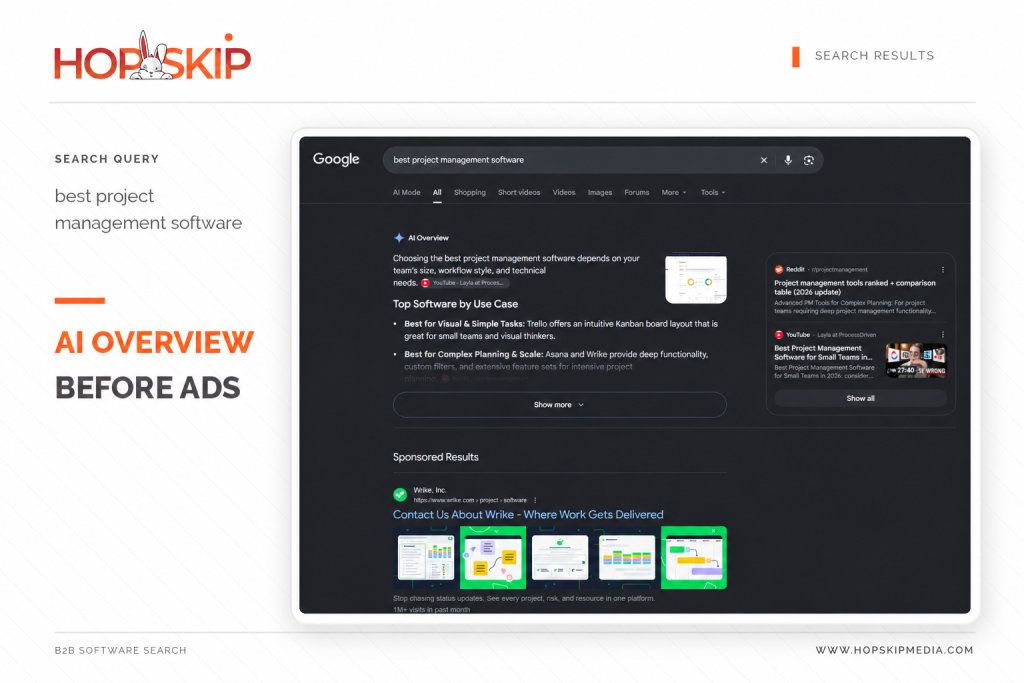
After Growth Hour, I ran a handful of these searches myself, incognito, mostly from Canada. On “salesforce demo,” a block of videos sat at the very top of the page, and the ads came after it; three of the four videos were creator tutorials. For “best project management software,” the AI Overview cited a creator’s YouTube video, and the ads sat below that. On “hubspot pricing,” there was no video at all. Seven searches in one afternoon is a tiny sample, and it’s exactly the check I’d want the team running on a client’s own terms.
Research first, then pick a route
Before we recommend anything to a client, the Hop Skip Media team would need to do the research to make the case. First, search the client’s own bid terms and note what shows up: whether there’s a video carousel, which videos sit in it, and where the ads land on the page. Run the searches from the locations the client actually advertises in; a VPN does the job. Then watch the videos themselves, because the ones Google picks show us what buyers see on the same page as our ad. This is the kind of research I meant a couple of weeks ago, in a conversation that started with Joey Bidner cutting his client list: the work only pays off when it ends in a recommendation.
Route 1: the creators already ranking
What the team finds decides where to start, and I’d start with the creators already ranking. Google announced Creator Partnerships in Google Ads at Google Marketing Live 2025. It expanded the feature in June 2026, so with the creator’s permission, you can run their existing video as an ad. Think of it as boosted UGC (user-generated content) on Meta, the Google version on YouTube. It’s a sponsorship or PR conversation too. Boosting that video buys ad placements; its organic spot in the results stays the creator’s. Those videos can run in top- and middle-of-funnel campaigns, and Google Ads lets you show them to people who recently searched specific terms on Google, so the terms the team audited become the audience. Two limits come with it: Google includes people who searched similar terms, and the “searched for” part only holds on Google’s own properties, like YouTube.
Route 2: your own videos
The second route is for the brand to make its own videos. If a video is already sitting on the results page for the client’s terms, there’s room to try for one of those spots (though I’m not an SEO, so evaluate the recommendation accordingly), and this route does need a second round of research before anyone writes a script. The brand needs its own YouTube channel for this anyway, both to show it knows its category and so a creator who recommends it has somewhere to send people. My hunch is that a creator tagging a brand’s channel does more than a link in the description; I obviously haven’t tested it.
For that research, the team would note how long each ranking video runs and how many views it has compared with the others in the same results, then look across the whole set for a common theme. If most of them answer the same question, that tells us what goes in the script, or in the brief if the client is making the video themselves. Sometimes the commonality is oddly specific; everyone’s in a black shirt or standing in front of a white screen. We’d treat those as clues to test, since a handful of videos is still a small sample.
Three months and a baseline
The goal sets the test window. If the goal is a halo effect, where people see the video and come back later through a branded search or another channel rather than buying straight from the ad, I’d commit to about three months so there’s time for the lift to show.
How long and how much also depends on treating YouTube as the channel it is. It can drive bottom-of-funnel conversions, but it usually sits at the top and middle of the funnel, and getting bottom-of-funnel results there is a lot harder than on Google Search, so go in expecting that. On budget, setting aside 5% to 10% of the ad budget for the test is a reasonable cap. Some teams stop a test once it hits a set number of impressions or clicks; I’m not a fan, because I don’t see how a YouTube test makes real ground in less than three months (and in some cases, you may need more time).
Paid: Search Lift where you can get it
On the paid side, Google’s Search Lift compares branded and product searches from people who saw your video ads against a held-out group who didn’t. It’s the cleanest read available, with a few catches. Not every account can use it; you need a Google rep to set it up, and each study runs 28 days and can come back “Not enough data” when volume is low, which is a real risk in small B2B categories. If an account doesn’t qualify, compare branded searches and conversions against a baseline from before the test, and label it a directional read.
Organic: correlation, clearly labelled
The organic side is harder. Search Lift only covers ads, so for the client’s own videos I’d look for incremental change: if conversions rise and nothing else changed across traditional, social, content or paid marketing at the same time, that’s a pretty decent correlation. It’s still correlation, and I’d say so in the report.
A research-stage play, for now
Everything above is a test plan, since my agency hasn’t seen this pattern in our own accounts and hasn’t run this test yet; we do plan to start research work to present this to a few clients in the coming months. A video showing up in the results tells us where buyers look while they research, which makes this a research-stage play and lines up with where YouTube sits in the funnel.
Matheus, one of our analysts, put the stakes plainly at Growth Hour. One of our B2B clients sells something so specific that the people who could use it often don’t know they need it, so they search the most generic terms in the world. Bid on those in Search and you pull in everyone. Clients want to pay for conversions, and only so many people are sitting at the bottom of the funnel; the rest of the demand has to be created. For a lot of B2B brands, the video already showing up in research-stage searches tells us where to start creating it.